The peanut-butter banana strawberry smoothy:
1 medium banana
1 cup vanilla soy milk
1 tsp sugar
1 tbsp creamy peanut butter
3/4 cup frozen strawberries
add banana, sugar, peanut-butter and soy milk to blender. Blend until smooth. Add strawberries. Blend in pulses to break up the berries, then blend until smooth. Super good. mmmmmmmm....
Thursday, April 19, 2007

Behold my New Flickr goodness... erm nearly goodness
I've started a Flickr account for the express purpose of posting pictures of the freight trains that roll on by my apartment. I've got the first few pictures up, focusing on graffiti on the cars, since my first attempts at digital photography were too bad for anything more subtle (I really want to eventually capture the interesting rust and age on the some of these big boxcars and tank-cars). This, I think, is the best of my first few pics... check 'em out!

Thursday, April 12, 2007
Kurt Vonnegut is Dead
Hi-Ho. Boing Boing has a collection of Vonnegut-related web stuff, by way of remembrance. I read about all of Vonnegut's work between my 15th and 20th year. His prose is still with me, I'll drop the imperative "Listen" into the body of an e-mail to indicate something that I feel must not be missed.
Vonnegut is most likely the ultimate source of my instinct - still somewhat operational after all the theory tried to train it out of me - that any complex system of belief is rationalization, that is bullshit, and that the truth is likely to be brutally simple. Most importantly, he taught me that we're all dying - whatever baroque fantasies we have constructed to convince ourselves otherwise notwithstanding - and that that probably ought to compel us to try to be kind to one another.
I'll miss you, Mr. Rosewater.
Vonnegut is most likely the ultimate source of my instinct - still somewhat operational after all the theory tried to train it out of me - that any complex system of belief is rationalization, that is bullshit, and that the truth is likely to be brutally simple. Most importantly, he taught me that we're all dying - whatever baroque fantasies we have constructed to convince ourselves otherwise notwithstanding - and that that probably ought to compel us to try to be kind to one another.
I'll miss you, Mr. Rosewater.
Friday, March 23, 2007
What do we do about the horror before us now?
So I'm watching the 1954 original cut of Godzilla, the non-Raymond Burr cut, Japanese with English subtitles and it gets to the part where they're trying to talk the scientist who invented the Oxygen Destroyer into letting them use his invention as a weapon against Godzilla. And the scientist gives an impassioned speech about how they can't do such a thing, because the Oxygen Destroyer would become another horrible superweapon in the hands of the world's politicians. And the leading man takes it all in, and seems pretty moved, and then says to the scientist: "But what do we do about the horror before us now? Do we just let it happen?"
And this is how I feel about liberal modernity these days. We know its failings and its horrors. We know about alienation and exploitation and imperialism and all the rest. But in the face of the rise of the terror of the anti-modern extremist right, a threat only liberal modernity seems prepared to face...
What do we do about the horror before us now?
And this is how I feel about liberal modernity these days. We know its failings and its horrors. We know about alienation and exploitation and imperialism and all the rest. But in the face of the rise of the terror of the anti-modern extremist right, a threat only liberal modernity seems prepared to face...
What do we do about the horror before us now?

The First Thing Stumbleupon brought me
Somekinda halo type thing.
I think its kinda neat.
I'd include it in the post but that seems to break blogger. Y'all will just have to click the link.
I think its kinda neat.
I'd include it in the post but that seems to break blogger. Y'all will just have to click the link.
Tuesday, March 20, 2007
30 Second Review of The Getaway
I like Peckinpah for his style and his composition. Not so much for his story lines or characterization. The, um, spousal abuse in his movies is, shall we say, problematic. Seriously, every movie of his I've seen features a "wife gets smacked around 'cause she needed it" scene. Not cool.
Also a "wife fucks bad guy right in front of husband and loves it because women is whores and can't be trusted" scene. Eeeeesh.
On a more positive, but nevertheless sorta weird, note the young Sally Struthers was kinda hot....
Also a "wife fucks bad guy right in front of husband and loves it because women is whores and can't be trusted" scene. Eeeeesh.
On a more positive, but nevertheless sorta weird, note the young Sally Struthers was kinda hot....
Baudrillard's laughter...
I was going to post something the day Baudrillard died, but then I forgot. Every so often though, you see something like this and you just know 'ol Jean is laughing back at you somewhere for every time you laughed at one of his far out theories.
I guess I should explain what that is, exactly. Its a clip from an upcoming showtime series to be based on the NPR program "This American Life". It tells the story of how toy TV cameras caught on as a fad at an elementary school, finally culminating in students standing by as one of their fellows is beaten up, dutifully "documenting" the fight with their fake TV cameras. Playing the part of the "disinterested journalist" even though all they had were props.
So the representation becomes the performance becomes the reality becomes the representation.
World without end
Amen.
I guess I should explain what that is, exactly. Its a clip from an upcoming showtime series to be based on the NPR program "This American Life". It tells the story of how toy TV cameras caught on as a fad at an elementary school, finally culminating in students standing by as one of their fellows is beaten up, dutifully "documenting" the fight with their fake TV cameras. Playing the part of the "disinterested journalist" even though all they had were props.
So the representation becomes the performance becomes the reality becomes the representation.
World without end
Amen.
Monday, March 19, 2007
Did the childrens really need to learn this?
In this segment, cookie monster teaches the children of the world an important lesson: museum exhibits are not for eating. I shit you not.
Tuesday, March 06, 2007
Thursday, February 15, 2007
Holy Crap
This cover of Springsteen's "Thunder Road" is frickin' amazing. Check that link while you can, its all kinds of illegal, but I just had to share it with y'all.
I happened to hear the song on WBER, my favorite radio station ever in all of history. It's a little community college station out of Rochester, New York that you used to be able to tune in where I grew up if you tilted the antenna just so. When I went off to college in Binghamton, New York I moved out of range of my beloved BER. My friend and sometime roomate (ever hear about those nightmare college roomies, yeah, that was um, me actually) Scott hailed from Rochester and shared my love of the station and missed it just as I did. We used to plot weird schemes to loft high-gain antennas on surplus weather balloons and pick it up that way as a way to pass the time in freshman physics. The balloons never got off the ground, but now I can pick up WBER's high-bandwidth stream on my wireless laptop as long as I have internet connectivity. Brave new world. The sound is slightly better than it used to be on the tilted just so FM receiver back home.
In other news, this cover renders "Thunder Road" eminently a cappella singable, much to the chagrin of my neighbors. :)
I happened to hear the song on WBER, my favorite radio station ever in all of history. It's a little community college station out of Rochester, New York that you used to be able to tune in where I grew up if you tilted the antenna just so. When I went off to college in Binghamton, New York I moved out of range of my beloved BER. My friend and sometime roomate (ever hear about those nightmare college roomies, yeah, that was um, me actually) Scott hailed from Rochester and shared my love of the station and missed it just as I did. We used to plot weird schemes to loft high-gain antennas on surplus weather balloons and pick it up that way as a way to pass the time in freshman physics. The balloons never got off the ground, but now I can pick up WBER's high-bandwidth stream on my wireless laptop as long as I have internet connectivity. Brave new world. The sound is slightly better than it used to be on the tilted just so FM receiver back home.
In other news, this cover renders "Thunder Road" eminently a cappella singable, much to the chagrin of my neighbors. :)
Wednesday, February 14, 2007
Level 3 Snow Emergency! Oh Noes!
We had some snow. And some wind. Snow + Wind looks like this:
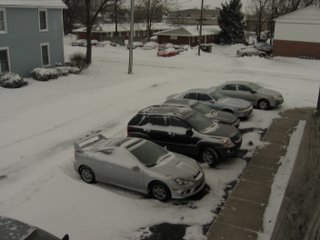
This is the windward side of my building.
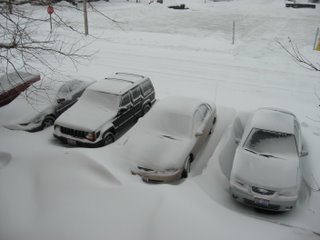
And this is the leeward side. Some may recognize my gold Taurus in the middle there. I got the wrong parking spot, I guess.
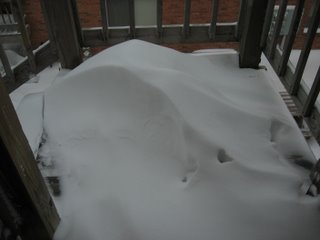
I found this outside my door. After I cleared the snow out of the door jamb.
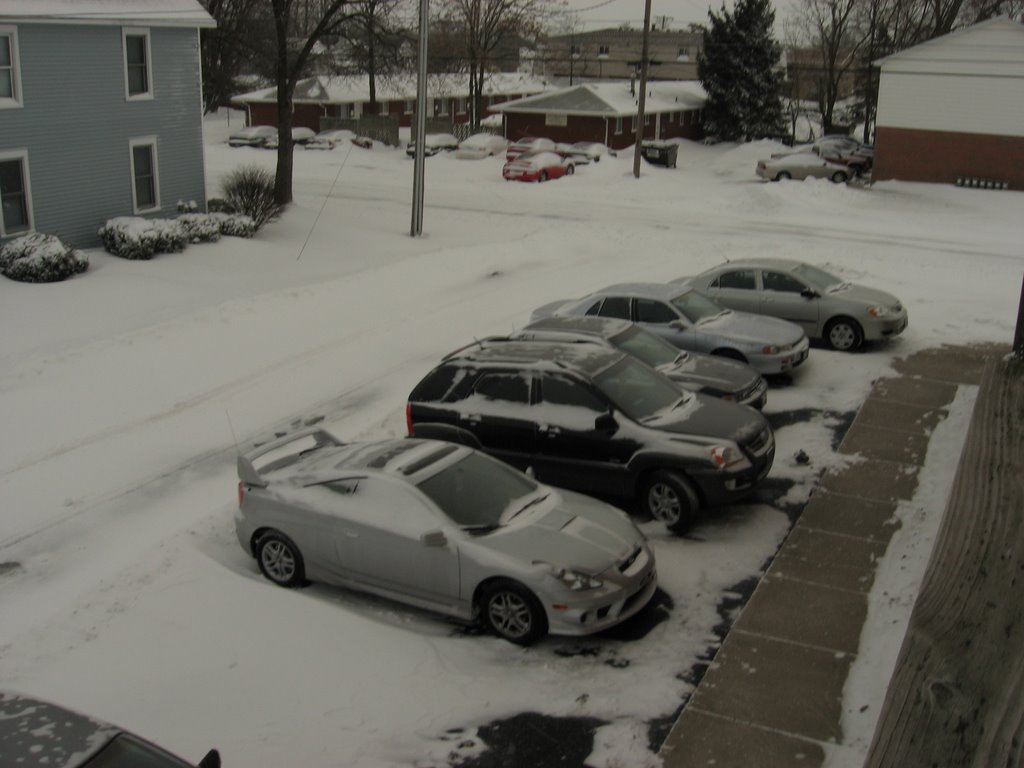
This is the windward side of my building.
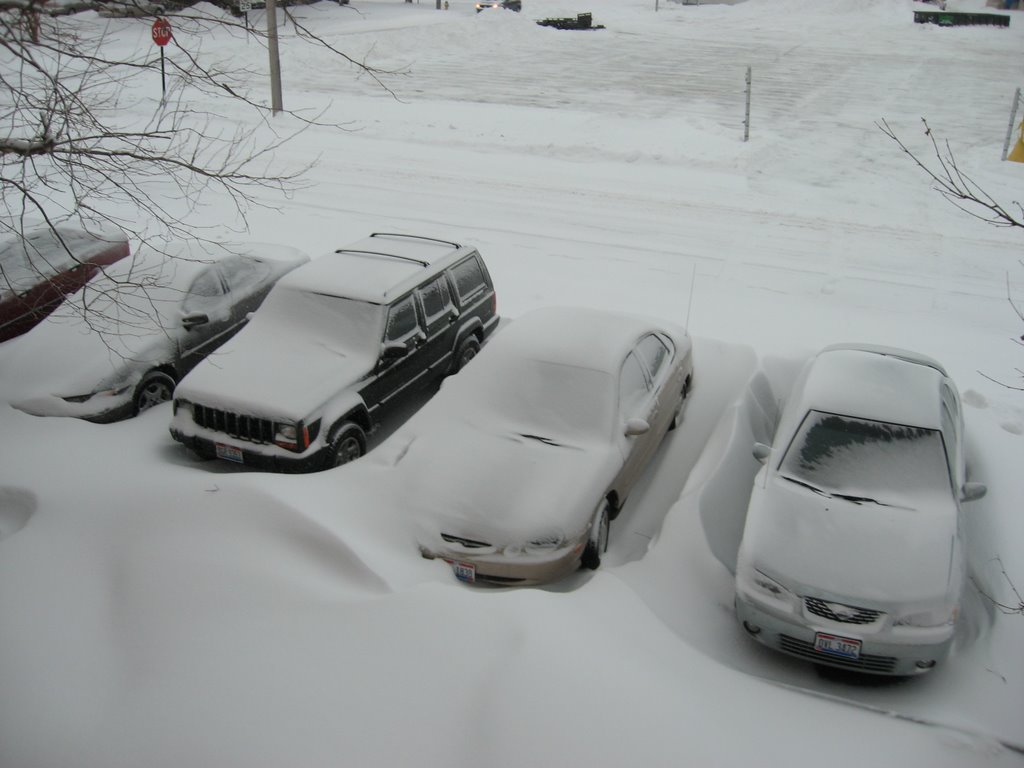
And this is the leeward side. Some may recognize my gold Taurus in the middle there. I got the wrong parking spot, I guess.
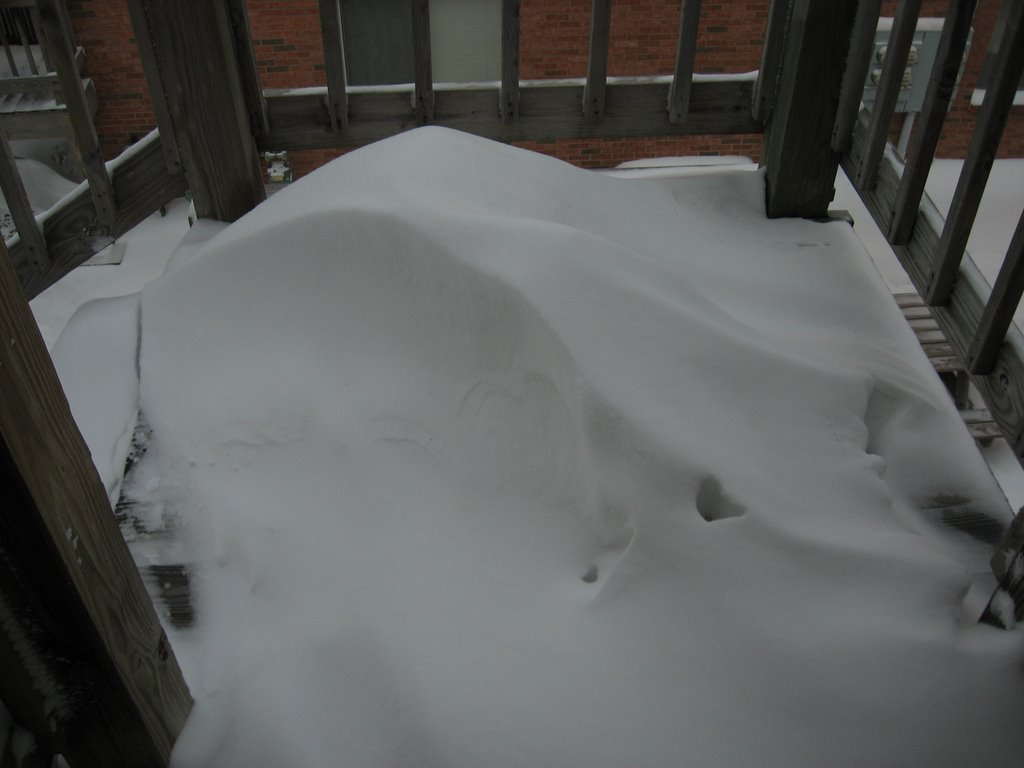
I found this outside my door. After I cleared the snow out of the door jamb.
Monday, February 05, 2007
Thursday, February 01, 2007
Notes on A Lost Country
I was in the media library of the Ethnic Studies department where I teach when I noticed on the shelf a book that had been important to me as a young adult, but that I had recently all but forgotten - Whitley Strieber and James Kunetka's War Day.
I picked it up and re-read it, of course, finding something else to read just like I always do when I should be doing my reading for courses or teaching.
Reading it again was surreal on two levels. First, the book itself is written in a faux-journalist style. The authors write from the point of view of themselves on a road trip through a post-nuclear-war America in what would be their future (the book was written in 1983, the characters within it write from the point of view of 1992, discussing the events leading up to and resulting from a nuclear war in 1988) and includes various chapters made up in the format of interviews of people living in post war America, as well as government documents describing such elements of the war's aftermath as nuclear fall-out patterns. As a whole, I found the style fairly convincing, the whole thing really does read like some kind of document dropped, a la Borges, into our reality from some alternate historical time-line. A monograph of a time that never was - but, with the nuclear sword of Damocles hanging over our heads for half a century, was still very real in our collective unconscious. It certainly was in mine.
It was that personal connection that made re-reading the book doubly strange. Nuclear war hung heavy in my mind as a young man, both as a terror and a hope. My utter repulsion at the notion of having to grow up, get a job, become a productive member of society doing as I was told was such that the bomb seemed a tantalizing alternative - that the boring world I was doomed to grow up and into might be washed away in a sudden flash of nuclear fire, replaced by a existence at once simpler and more romantic. A world where derelict buildings and vehicles could be claimed at will, where (my naive young self imagined) a sort of techno-pastoralism would reign - high tech ruins and happy farmers.
Even then, I knew this was unrealistic, but the image was still a powerful one. It is not, I realize upon my re-reading of Warday, the image Warday gives of post-war existence (which it painstakingly renders the hardships of) but the images of Warday shaped my vision of postwar existence. It contains a scene set in a partially bombed New York (in the novel, the set of bombs meant for New York misses and strikes Queens and Brooklyn) that I realized I had lifted for the first short story I had ever written (which imagined three friends living a post-apocalyptic pastoral existence setting out to see the ruins of New York). That story would morph into a story I would tell to an ex-girlfriend in the middle of the night when she would turn to me, half asleep and ask me to tell her a story (as one gets asked when one identifies oneself as a fiction writer). The night-time story (about friends living a pastoral existence raising vegetables in the ruins of a wasted New York) would be included in, ironically enough, the last story I ever wrote.
Like the image of ruined New York many other things in the novel, I realized, were landmarks in my memory. Great prominent image features, always at least dimly visible in my mind.
Visible, but transformed since I first knew them. The book was, for me, an artifact from another lost country, that of my own childhood. Strange and a little sad to stumble upon.
I was wistful about that for a day or so, the loss of childhood, of certain ideas about the world and myself, of the girl I used to tell that story to. But then something else happened. Something very mundane, really. I was out late at night, returning a video, all bundeled up against the cold, with my high-tech ipod playing the new Shins album in my ear, and the snow was powdery and sparkling and bright...
and it just struck me: It's a good thing the bombs never fell.
I have a job I take some satisfaction in, I have my little apartment, my recipes, my friends, my library, all privileges to be sure, but
It's a good thing the bombs never fell.
Now let's just hope we get past this peak oil thing without burning the place down.
I picked it up and re-read it, of course, finding something else to read just like I always do when I should be doing my reading for courses or teaching.
Reading it again was surreal on two levels. First, the book itself is written in a faux-journalist style. The authors write from the point of view of themselves on a road trip through a post-nuclear-war America in what would be their future (the book was written in 1983, the characters within it write from the point of view of 1992, discussing the events leading up to and resulting from a nuclear war in 1988) and includes various chapters made up in the format of interviews of people living in post war America, as well as government documents describing such elements of the war's aftermath as nuclear fall-out patterns. As a whole, I found the style fairly convincing, the whole thing really does read like some kind of document dropped, a la Borges, into our reality from some alternate historical time-line. A monograph of a time that never was - but, with the nuclear sword of Damocles hanging over our heads for half a century, was still very real in our collective unconscious. It certainly was in mine.
It was that personal connection that made re-reading the book doubly strange. Nuclear war hung heavy in my mind as a young man, both as a terror and a hope. My utter repulsion at the notion of having to grow up, get a job, become a productive member of society doing as I was told was such that the bomb seemed a tantalizing alternative - that the boring world I was doomed to grow up and into might be washed away in a sudden flash of nuclear fire, replaced by a existence at once simpler and more romantic. A world where derelict buildings and vehicles could be claimed at will, where (my naive young self imagined) a sort of techno-pastoralism would reign - high tech ruins and happy farmers.
Even then, I knew this was unrealistic, but the image was still a powerful one. It is not, I realize upon my re-reading of Warday, the image Warday gives of post-war existence (which it painstakingly renders the hardships of) but the images of Warday shaped my vision of postwar existence. It contains a scene set in a partially bombed New York (in the novel, the set of bombs meant for New York misses and strikes Queens and Brooklyn) that I realized I had lifted for the first short story I had ever written (which imagined three friends living a post-apocalyptic pastoral existence setting out to see the ruins of New York). That story would morph into a story I would tell to an ex-girlfriend in the middle of the night when she would turn to me, half asleep and ask me to tell her a story (as one gets asked when one identifies oneself as a fiction writer). The night-time story (about friends living a pastoral existence raising vegetables in the ruins of a wasted New York) would be included in, ironically enough, the last story I ever wrote.
Like the image of ruined New York many other things in the novel, I realized, were landmarks in my memory. Great prominent image features, always at least dimly visible in my mind.
Visible, but transformed since I first knew them. The book was, for me, an artifact from another lost country, that of my own childhood. Strange and a little sad to stumble upon.
I was wistful about that for a day or so, the loss of childhood, of certain ideas about the world and myself, of the girl I used to tell that story to. But then something else happened. Something very mundane, really. I was out late at night, returning a video, all bundeled up against the cold, with my high-tech ipod playing the new Shins album in my ear, and the snow was powdery and sparkling and bright...
and it just struck me: It's a good thing the bombs never fell.
I have a job I take some satisfaction in, I have my little apartment, my recipes, my friends, my library, all privileges to be sure, but
It's a good thing the bombs never fell.
Now let's just hope we get past this peak oil thing without burning the place down.
Monday, January 15, 2007
This is what happens when I read too much Gibson
I get his narrative voice stuck in my head, and I start hearing it narrate my life, like this:
Changing the Batteries in My Digital Camera:
He notices the little icon flash up on the Canons rear LCD, a red pixellated thing that was apparently meant to suggest a battery in some abstract sense. Probably designed by committee, he thinks, focus-grouped to ensure maximum communicative potential across the 7 or 8 linguistic families Canon planned on marketing this little hunk of plastic to. He walks to the kitchen, pops the tiny battery cover cap open to reveal the twin silver nickel-hydride rechargeable batteries nestled next to the blue plastic of the camera's gigabyte memory card. Chuckles to himself as he remembers the day, almost fifteen years ago now, when he had scraped together $200 of Christmas money and weekly allowance to buy four megabytes of system RAM for his old 80486 PC - a putty colored aluminum box the size and weight of a microwave oven - remembers walking into the ozone smelling electronics store in the strip mall by the China Wok restaurant, walking out with the two green memory modules studded with black rectangular chips as big as a thumbnail, gold plated contacts shining in the winter sun. What, he wonders, would the boy who had just payed $50 a megabyte for giant sticks of system RAM would say if he could somehow let him know that in the near future (how near was it though, really, those fifteen years were his whole life, after all) you could pick up a neatly bubble-packaged bit of blue plastic containing a gigabyte of as-yet undeveloped memory technology for 40 bucks? Probably something along the lines of, you've gotta be shitting me, mister.
Which, he realizes as the long silver batteries land with a muted metal thunk on the countertop, is an appropriate thing to think now - given that he's just blown his last set of rechargeables with a video assignment due in just a few hours. Somewhere in his mess of a junk drawer he knows he has a last pair of alkalines stashed away for an emergency of just this nature. A few seconds rifling through the various small tools and pack-rat hoarded detrius: four small screwdrivers; a washer he found on the railroad tracks, warped and bent by the passing train; a neon-yellow super-high-bounce ball of the sort he used to buy from coin-op prize machines because a certain someone had this geeky, adorable fascination with them; and he's found the batteries - classic copper on black colors shining like the herald of some chivalrous centipede. Slotting them into the Canon, he knows he has only a few minutes of video capture before they give out - its designers had traded energy economy for parts economy, drove down the price point of their hardware while sticking the buyer with the price of consumables, caveat emptor he supposed. Still, it was better than nothing in a pinch.
Changing the Batteries in My Digital Camera:
He notices the little icon flash up on the Canons rear LCD, a red pixellated thing that was apparently meant to suggest a battery in some abstract sense. Probably designed by committee, he thinks, focus-grouped to ensure maximum communicative potential across the 7 or 8 linguistic families Canon planned on marketing this little hunk of plastic to. He walks to the kitchen, pops the tiny battery cover cap open to reveal the twin silver nickel-hydride rechargeable batteries nestled next to the blue plastic of the camera's gigabyte memory card. Chuckles to himself as he remembers the day, almost fifteen years ago now, when he had scraped together $200 of Christmas money and weekly allowance to buy four megabytes of system RAM for his old 80486 PC - a putty colored aluminum box the size and weight of a microwave oven - remembers walking into the ozone smelling electronics store in the strip mall by the China Wok restaurant, walking out with the two green memory modules studded with black rectangular chips as big as a thumbnail, gold plated contacts shining in the winter sun. What, he wonders, would the boy who had just payed $50 a megabyte for giant sticks of system RAM would say if he could somehow let him know that in the near future (how near was it though, really, those fifteen years were his whole life, after all) you could pick up a neatly bubble-packaged bit of blue plastic containing a gigabyte of as-yet undeveloped memory technology for 40 bucks? Probably something along the lines of, you've gotta be shitting me, mister.
Which, he realizes as the long silver batteries land with a muted metal thunk on the countertop, is an appropriate thing to think now - given that he's just blown his last set of rechargeables with a video assignment due in just a few hours. Somewhere in his mess of a junk drawer he knows he has a last pair of alkalines stashed away for an emergency of just this nature. A few seconds rifling through the various small tools and pack-rat hoarded detrius: four small screwdrivers; a washer he found on the railroad tracks, warped and bent by the passing train; a neon-yellow super-high-bounce ball of the sort he used to buy from coin-op prize machines because a certain someone had this geeky, adorable fascination with them; and he's found the batteries - classic copper on black colors shining like the herald of some chivalrous centipede. Slotting them into the Canon, he knows he has only a few minutes of video capture before they give out - its designers had traded energy economy for parts economy, drove down the price point of their hardware while sticking the buyer with the price of consumables, caveat emptor he supposed. Still, it was better than nothing in a pinch.
Thursday, January 11, 2007
My Narcissistic Use of Imaging Technology Continues
Today, for your viewing pleasure, a movie of the Midnight Train to My house. Well, it goes to my house if you ride the Freights and are willing to jump off while the train is cruising at a fairly good clip.
Sunday, January 07, 2007

Saturday, January 06, 2007
Documenting where I live
Some pics from the new digital camera. Lets see if ol' blogger renders them reasonably well, if I need a flickr account.
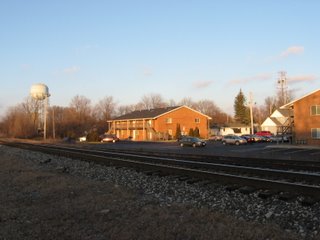 My apartment complex.
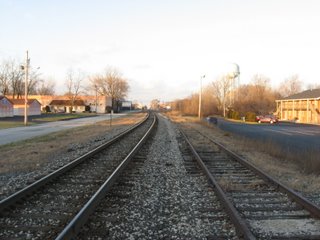 The rail-line outside the window. Fun when I'm awake. Not always so much when I'm asleep.
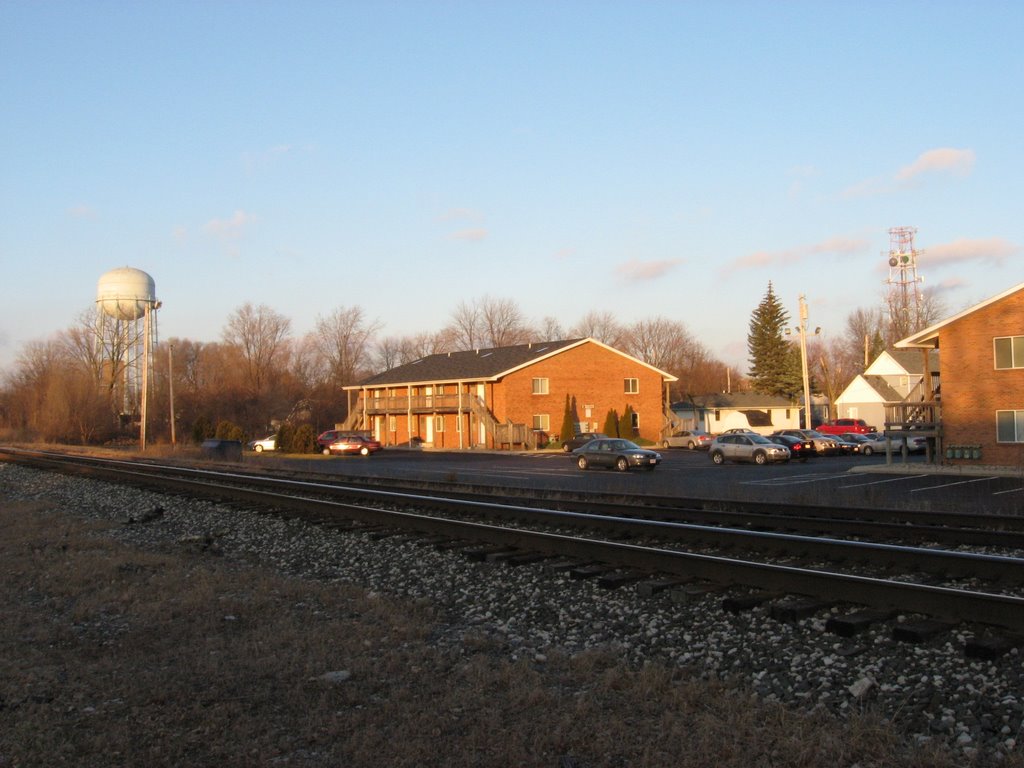 My apartment complex.
 The rail-line outside the window. Fun when I'm awake. Not always so much when I'm asleep.
Subscribe to:
Posts (Atom)


